


Commercial Claims Need a Defensible Damage Scope

A commercial property loss can appear straightforward until the carrier’s estimate arrives. A section of roof is damaged, water entered a tenant space, or fire and smoke affected part of a building. Yet commercial claims often turn on issues that are not visible in a first walk-through: whether matching materials are available, whether wet assemblies can dry in place, whether code upgrades apply, and whether a limited repair will restore the property to its pre-loss condition.
For a business owner or commercial landlord, an incomplete scope is not merely an insurance disagreement. It can mean extended downtime, unsafe conditions, tenant disruption, lost revenue, and a repair plan that creates future failures. The claim must be approached as a technical property-damage matter supported by policy language, not as a quick exchange of competing estimates.
Why Commercial Claims Become Disputed
Commercial buildings have systems, not isolated components. A wind event can damage roof coverings while also affecting flashings, rooftop penetrations, gutters, insulation, and interior finishes. A plumbing failure may travel through floor assemblies and wall cavities before it becomes visible below. A fire can leave smoke residue in HVAC pathways, concealed framing, electrical equipment, and inventory areas that were not directly burned.
Carrier inspections are often limited by time, access, or the scope of the initial report. An adjuster may identify obvious direct physical damage but omit resulting damage that requires specialized assessment. The initial scope may also assume localized repair is appropriate without fully evaluating material availability, manufacturer requirements, code compliance, or the condition of adjacent assemblies.
That does not mean every damaged building requires full replacement of every system. The proper answer depends on the evidence. A defensible claim distinguishes documented damage from pre-existing wear, identifies the necessary repair method, and explains why a partial repair either can or cannot restore the property properly.
The estimate is not the claim
An estimate is one tool within a claim. It may price labor and materials, but it does not automatically establish cause, extent, repairability, policy coverage, business interruption exposure, or code-related costs. When an estimate is built before the damage is thoroughly investigated, it can lock the discussion into a scope that is too narrow from the start.
Commercial policyholders need to examine the carrier’s scope line by line. Missing items are often buried in assumptions: no allowance for detaching and resetting equipment, no access costs, no moisture mapping, no testing, no overhead and profit where warranted, or no consideration of the work needed to return occupied areas to safe use.
Building the Evidence Before the Scope Is Fixed
The strongest commercial claims begin with disciplined documentation. Photos alone are rarely enough for a complex loss. The evidence should connect the event, the observed conditions, the affected building materials, the repair method, and the resulting cost.
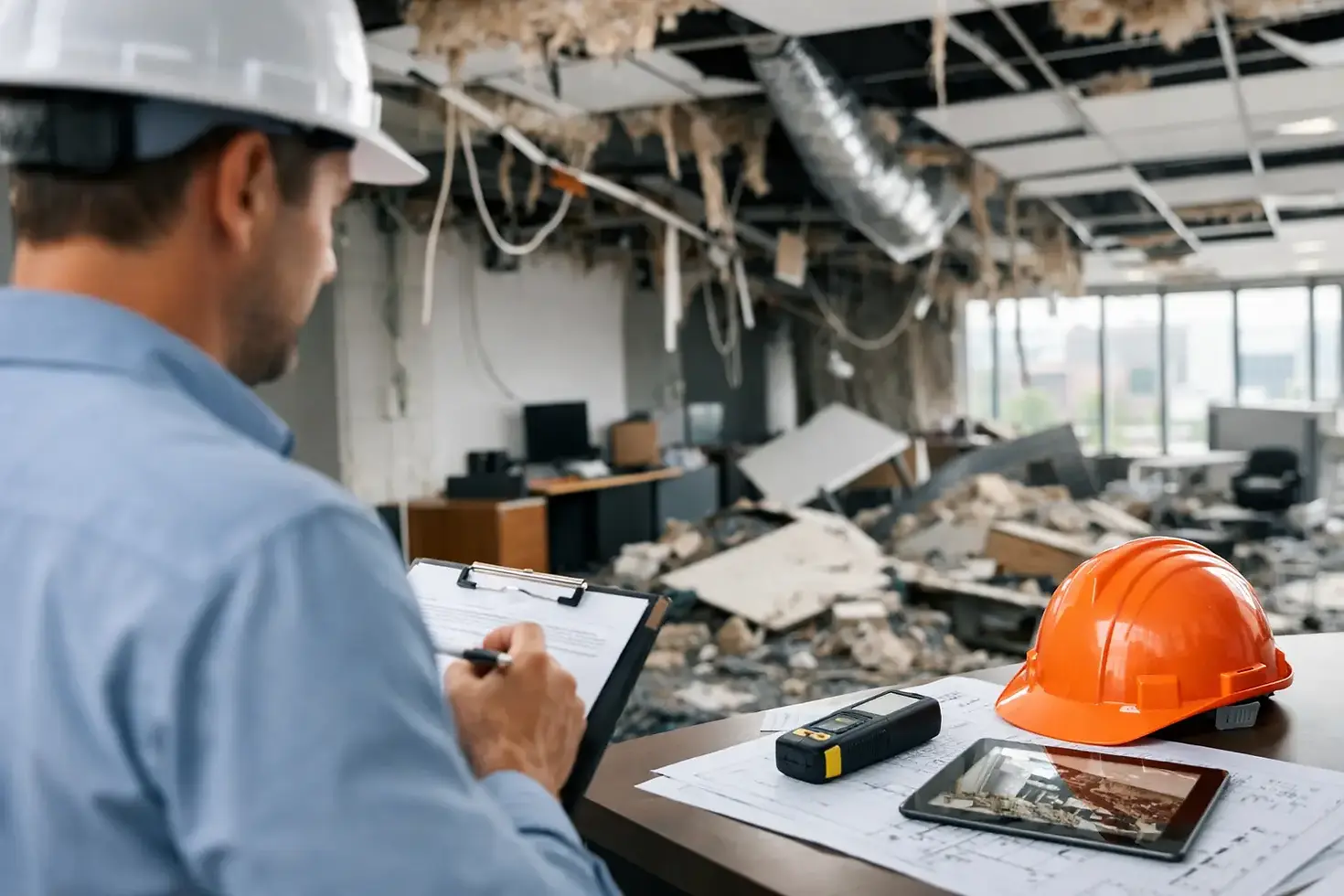
A thorough property assessment may include exterior and interior photographs, measurements, material identification, moisture readings, thermal images, roof test areas where appropriate, equipment documentation, and records of temporary mitigation. It should also document conditions that may disappear during emergency work, such as standing water, removed insulation, damaged ceiling tile, wet wallboard, or smoke contamination.
Hidden moisture changes the repair decision
Water damage is frequently under-scoped because the visible stain is treated as the full extent of the loss. Water does not stop at the edge of a stain. It can migrate through insulation, beneath flooring, into wall cavities, along framing, and into mechanical chases.
Level 1 infrared thermography can help identify temperature differentials consistent with concealed moisture, particularly when used with moisture meters and physical verification. Infrared imagery is not a stand-alone diagnosis. Its value is in directing further investigation and documenting why additional opening, drying, removal, or testing is justified.
A commercial tenant space may look dry after surface cleanup while moisture remains behind baseboards or beneath resilient flooring. If those materials are closed without proper assessment, mold growth, odor, flooring failure, and later tenant complaints can follow. The claim documentation should show the condition of the assembly at the time of loss and the rationale for the selected restoration method.
Roof repairability requires more than a visual opinion
Wind and hail losses create another common scope dispute. A carrier may allow replacement of individual shingles, tiles, panels, or membrane sections. The practical question is whether those repairs can be performed without causing additional damage or leaving the roof unable to function as intended.
Repairability assessments evaluate factors such as material brittleness, fastening methods, bond strength, slope configuration, weathering, discontinuation, and the accessibility of affected areas. A NAFI-style roof repairability assessment can document whether a proposed repair is feasible under field conditions rather than simply assuming that replacement pieces can be inserted.
This distinction matters for commercial properties with large roof areas, multiple elevations, rooftop units, solar equipment, or complex drainage. A narrow patch may be reasonable in one location and technically unsound in another. The evidence should address the actual roof system, not a generic repair theory.
Policy Terms Must Be Read With the Property in Mind
Commercial property policies are contracts with conditions, exclusions, deductibles, limits, and endorsements. The policy must be reviewed before major coverage positions are accepted or repairs are finalized. A practical claims analysis considers how the policy language applies to the building and operations at issue.
Areas that deserve close review include replacement cost provisions, actual cash value provisions, ordinance or law coverage, protective safeguards requirements, vacancy conditions, flood or water exclusions, wind or hail deductibles, debris removal, pollution or contamination provisions, and business income coverage. The exact terms vary widely, including among policies that appear similar on the declarations page.
Code-related costs are particularly important in older commercial buildings. Rebuilding a damaged portion may trigger requirements for electrical upgrades, fire protection, accessibility, energy efficiency, or structural improvements. Coverage for those costs may be limited or subject to specific conditions. The right question is not whether code work is inconvenient or expensive. It is whether the loss-related repair requires it and whether the policy provides applicable coverage.
Business Interruption Needs Its Own Documentation
Property damage and income loss are related, but they are not the same claim component. A business may suffer a legitimate interruption even when part of the building remains standing and some operations continue. Reduced hours, closed areas, lost tenants, canceled bookings, restricted access, damaged equipment, and delayed reopening can all affect revenue.
The documentation should establish the period of restoration based on the work actually required, not an optimistic schedule built around an incomplete repair scope. Keep sales records, occupancy reports, payroll information, invoices, lease records, cancellation data, and communications showing how the physical loss affected operations.
Mitigation remains essential. Policyholders should take reasonable steps to protect the property and limit further damage, while preserving receipts, photographs, and work records. Mitigation is not an admission that the insurer’s scope is correct. It is responsible loss management.
How to Respond to an Underpaid or Limited Scope
When a carrier issues a payment that does not match the documented damage, avoid responding with a vague demand for more money. A focused response is more effective. Identify the missing or inadequate line items, provide the field evidence, explain the repair or replacement requirement, and connect the issue to the policy where appropriate.
The discussion should remain professional and specific. For example, rather than stating that a roof “needs replacement,” explain why the tested material fractured during attempted manipulation, why the damaged area cannot be accessed without disturbing adjoining materials, or why a proposed repair would compromise the system. Rather than stating that water affected “the whole suite,” provide moisture mapping, room measurements, material findings, and the scope required to return each assembly to a dry and sanitary condition.
Time also matters. Commercial policies contain notice obligations, proof-of-loss requirements, examination-under-oath provisions, and suit limitation language. Do not allow a prolonged adjustment process to cause critical deadlines to pass. At the same time, do not rush into a final settlement before the property has been fully investigated and the scope has been reviewed.
For complex or disputed losses, a public adjuster can provide field-based damage documentation, scope analysis, and direct negotiation support. Stokes Public Adjusters approaches these matters with the technical discipline needed to test repair assumptions, identify concealed conditions, and present a claim that reflects the actual work required.
A commercial property deserves a repair plan that protects the building, its occupants, and the business operating within it. Before accepting a limited scope, make sure the evidence answers the question that matters most: will this settlement truly restore the property after the loss?



Comments