



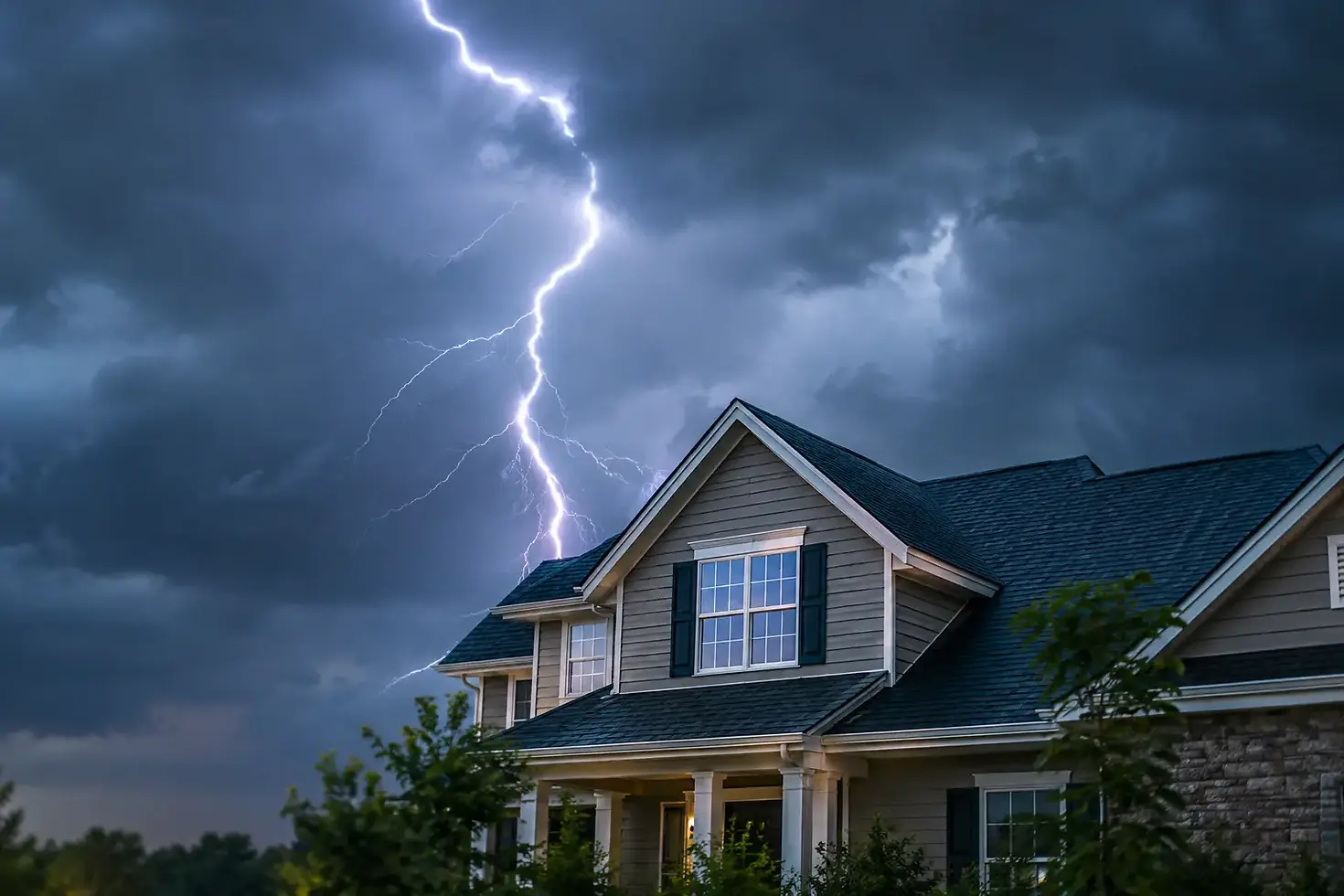
Are Lightning Claims Covered by Insurance?

A lightning strike can damage far more than the place where it appears to hit. A homeowner may see a scorched tree or damaged roofline, while a business owner may first notice failed HVAC controls, burned circuit boards, disabled security systems, or a refrigeration loss. So, are lightning claims covered? In many cases, yes. But coverage depends on the policy language, the type of damage, applicable deductibles, and whether the full scope of direct physical damage is properly documented.
Lightning losses are often under-scoped because the most expensive damage may be inside the building, behind walls, or within connected electrical systems. A quick visual inspection is rarely enough to establish the true extent of the loss.
Are Lightning Claims Covered Under Property Insurance?
Most homeowners, commercial property, and businessowners policies list lightning as a covered cause of loss. A direct strike to the insured structure is generally a straightforward coverage event when it causes physical damage. That may include damage to roofing, siding, chimneys, electrical service equipment, appliances, wiring, plumbing components, fire alarm systems, and other building systems.
Coverage is not limited to a dramatic hole in the roof. Lightning can travel through utility lines, telephone lines, cable lines, metal plumbing, and grounded components. A nearby strike can create a power surge that damages equipment without leaving obvious exterior evidence. The practical issue is often not whether lightning is covered in the abstract. It is whether the policyholder can connect the claimed damage to the lightning event and establish that the proposed repairs are necessary.
The policy itself controls. Forms vary, and commercial policies may contain endorsements, equipment breakdown provisions, protective safeguard requirements, special sublimits, or exclusions that affect payment. A careful claim review should identify the coverage grant, exclusions, conditions, deductibles, depreciation provisions, and replacement cost requirements before accepting the carrier's scope.
Direct Strike Damage and Power Surge Damage
A direct strike is only one form of lightning loss. When lightning contacts a structure, utility equipment, or nearby ground, it can produce heat, shock, arc damage, and electrical surges. Those forces can affect systems throughout the property.
Direct physical damage may include burned conductors, damaged meter bases, compromised electrical panels, cracked masonry, roof punctures, fire damage, and damaged grounding equipment. Secondary damage can be equally significant. A voltage surge may destroy compressors, furnaces, smart appliances, servers, gate operators, elevators, cameras, irrigation controls, or point-of-sale equipment.
Electrical components do not always fail immediately. A surge can weaken a circuit board, control module, capacitor, or relay and cause intermittent failures days later. That timing can complicate a claim, especially if the carrier assumes that a later equipment failure is unrelated wear and tear. A qualified electrician, equipment technician, or manufacturer representative may be needed to identify surge signatures, damaged components, and whether repair will restore safe, reliable operation.
For commercial properties, the loss may also extend beyond building repairs. Damaged machinery, spoiled inventory, interrupted operations, lost rental income, and extra expense can be covered under the right policy provisions. Those losses require their own documentation and should not be treated as an afterthought to the building claim.
Why Lightning Claims Are Frequently Underpaid
Lightning claims commonly become disputes when the inspection focuses only on visible damage. If an adjuster sees no major roof opening or obvious fire, the carrier may limit the claim to a small electrical repair. That approach can miss hidden damage to wiring, building systems, moisture barriers, and connected equipment.
Roof damage deserves particular attention when a strike contacts or travels across the roof assembly. Heat and electrical discharge can damage shingles, underlayment, flashing, fasteners, decking, gutters, and roof-mounted equipment. The proper repair question is not simply whether one visible area can be patched. It is whether the roof can be returned to its pre-loss condition with a repair that is technically sound, code-compliant, and reasonably uniform in appearance and performance.
Repairability matters. If damaged materials cannot be matched, if repairs would disturb adjacent brittle materials, or if the roof system has sustained dispersed damage, a limited repair may not be an appropriate restoration method. The same principle applies to siding, electrical systems, and interior finishes. A carrier's first scope is an estimate, not a final determination of the full loss.
Another dispute involves causation. Carriers may attribute failed electronics to age, corrosion, manufacturing defects, deferred maintenance, or ordinary mechanical breakdown. Those conditions can be relevant, but they do not automatically eliminate coverage when a lightning event caused new damage or materially worsened a condition. The evidence must separate pre-existing conditions from damage caused by the event.
Evidence That Strengthens a Lightning Damage Claim
The strongest lightning claim file tells a complete causation story. It documents the storm event, identifies the damaged property, explains how lightning affected each component, and supports the required repair or replacement scope.
Start with photographs and video taken as soon as it is safe to do so. Capture exterior strike indicators, damaged trees, roof areas, service entrances, electrical panels, appliances, alarms, and all affected rooms. Do not discard damaged equipment before it has been inspected and documented. Its condition may be central evidence of the loss.
Obtain diagnostic reports rather than relying only on a repair invoice. An electrician's report should identify observed damage, testing performed, recommended corrective work, and the basis for relating the damage to a surge or lightning event. For specialized systems, request reports from qualified HVAC, security, fire suppression, elevator, solar, data, or refrigeration professionals.
A thorough property inspection should also evaluate concealed conditions. Water can enter through a compromised roof assembly after a strike, creating hidden moisture in insulation, decking, ceiling cavities, or wall systems. Infrared thermography can help identify anomalous moisture patterns that are not visible during a basic walkthrough. Where moisture is indicated, appropriate verification and a documented drying or repair protocol may be necessary.
Keep a timeline of the event, symptoms, inspections, temporary repairs, communications, and business impacts. For a commercial loss, preserve sales records, payroll data, inventory records, lease information, utility records, and receipts for extra expenses. A well-organized file gives the carrier less room to characterize documented damage as speculation.
Policy Conditions Still Matter
Even when lightning is a covered peril, policyholders must comply with post-loss duties. Most policies require prompt notice, reasonable steps to protect the property from further damage, cooperation with the investigation, and documentation of the loss. Failing to mitigate can create an avoidable dispute.
Mitigation does not mean performing permanent repairs before the damage is documented. It means preventing additional harm. Cover a roof opening, remove standing water, secure exposed electrical hazards, and protect undamaged contents where possible. Retain invoices, photographs, and samples of damaged materials. If emergency work is needed, document conditions before, during, and after the work.
Deductibles can also affect the economics of a claim. Some policies apply a standard deductible, while others use a separate wind, named storm, or percentage deductible. A lightning loss does not automatically fall under every storm deductible, so the exact policy wording should be reviewed rather than assumed.
When a Claim Needs a More Technical Review
A more detailed evaluation is warranted when the carrier denies surge-related equipment, limits the scope to a small repair, omits interior or hidden moisture damage, disputes roof repairability, or offers a settlement that does not restore the property to its pre-loss condition. These are not merely pricing disagreements. They are often documentation and causation disputes.
An experienced public adjuster can inspect the property, assess repairability, coordinate technical evidence, analyze the carrier's estimate against the actual damage, and present a supported claim scope for negotiation. Stokes Public Adjusters approaches lightning losses with the same field-based discipline required for other complex property claims: identify the direct physical damage, document what is concealed, and defend the work necessary for proper restoration.
If lightning affected your property, do not let the absence of a visible crater determine the claim. Preserve the evidence, obtain qualified diagnostics, and make sure the loss is evaluated as a building and systems event, not just a single damaged component.


Comments